
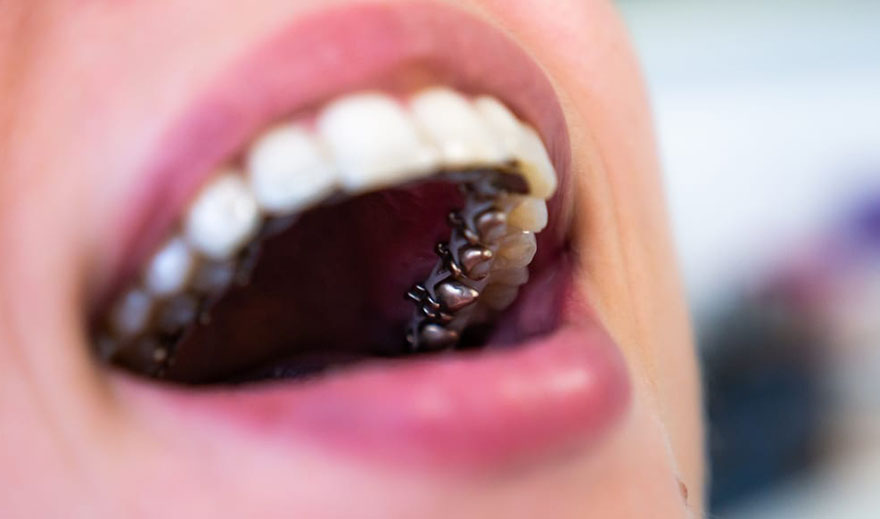
Lingual braces at Antalya Dental Hospital, Turkey
Lingual braces: What Are They, Benefits and Cost
Hide your braces.
Show off your smile.
Now more than ever, people are becoming more aware of the benefits of a beautiful, healthy smile.
For those who are do not like to draw attention to their ongoing orthodontic treatment, Incognito lingual braces at the Antalya Dental Hospital could be a great option.
Invisible braces, also called lingual or hidden braces are fitted behind the teeth so you can’t see them at all. They are 100% customized to the shape of your own teeth for comfort and to give you outstanding results. Lingual braces are especially ideal for teens and adults who require orthodontic treatment but do not wish to compromise their appearance.
Need more advice?
If you need free and impartial advice about your oral health, contact our Antalya Dental Hospital Helpline by email or call +90 242-999-1227 (local rate call in the Turkey).
Our Antalya Dental Hospital Helpline is completely confidential and has helped almost 20,000+ people. Contact our experts by telephone, email or online enquiry, Monday to Friday, 08:00 - 18:00.



Frequently Asked Questions About Dental Health
FAQs
Our FAQs are the most commonly-asked questions put to our Dental Helpline over the last year. If you have a question for us, you can ask our Dental Helpline by telephone or email. Alternatively, please take a look at our library of oral health information, which contains a wide range of oral health advice in an easy-to-understand Q&A format.
Early tooth decay does not tend to show many physical signs. Sometimes the tooth looks healthy, but your dental team will be able to see from an x-ray whether you have any decay under the enamel, any possible infections in the root, or any bone loss around the tooth.
X-rays can help the dental team to see in between your teeth or under the edge of your fillings. Finding and treating dental problems at an early stage can save both time and money.
In children, x-rays can be used to show where the adult teeth are and when they will appear. They are also used in the same way for adults when the wisdom teeth start to come through.
Most teeth attached to implants can only be fitted and removed by the dentist. However, if you have removable dentures attached to the implants, you’ll be able to take them out for cleaning.
In the past, a root-filled tooth would often darken after treatment. However, with modern techniques this does not usually happen. If there is any discolouration, there are several treatments that will restore the natural appearance.
In root-filled teeth it may be necessary to insert a post into the tooth root before placing a crown. A post gives support and helps the crown to stay in place. The surface of the tooth may be removed down to the level of the gum.
A post can be made of prefabricated stainless steel which the dentist can fit directly into the root canal. Or a custom-made post can be constructed by a dental technician to accurately fit the shape of the prepared root canal. The post is placed into the root canal and cemented in position, ready for the crown to be attached.
Your Best Smile Starts Here
Follow along as Antalya Dental Hospital expert dentists share the latest oral health trends that impact you and your family’s overall health. Dentistry and Oral Health Blog is a rich source of information about dentistry, dental care, tips, news and more. Subscribe to our blog, newsroom and social media.
Smoking and oral health
It’s no secret that smoking is bad for your general

Visiting a dental hygienist or dental therapist
What are dental hygienists and dental therapists? Dental hygienists and dental

Transfer 3D computer tomography (CT) via the Internet
Computed tomography of maxillofacial department (teeth picture in 3D) -